Friday, June 26, 2020

#52 Ancestors 2020 Week 26 Middle


#52 Ancestors 2020

Week 26 Middle


Giles Armitage Mason

 My cousin Mark is the only Mason descendant of our generation with the middle name Giles.  He understands that he got the name from his grandfather, Alfred Giles Whitten, and the family story was that Alf’s parents were impressed by the heroics of the Australian explorer, Ernest Giles, the first white explorer to cross the deserts of Central and Western Australia, and the first white man to see the Olgas (Kata Tjuta).

This may well be true, but there are at least six other members of the family called Giles, most of them older than Alf, which suggests that the name has another significance.  I set out to investigate who they all were.

The first Giles I can verify is Giles Armitage Mason (1837 -1912) who was the eldest son of our 2 x great grandparents, Richard and Jane (Armitage) Mason.  Calling their first born Giles would usually indicate that there was a parent or grandparent of that name – Irish families generally followed that pattern of naming and their first two girls were named for their mothers, Phoebe and Grace.  However, Jane’s father was Richard Armitage, Richard’s was Peter Mason and we know that one grandfather was William Powell.  No Giles has yet been found.  The complexities of Protestant Irish records of the period make it particularly difficult.

Giles Mason was only five when the family arrived in Australia.  There is little known about him, but we know he married Mary Ann Sisley and they had two daughters.  Judging from her obituary in “The Methodist”, in 1922,* Mary Ann was a pious soul, so one wonders why she and Giles appear not to have lived together for very long.  The obituary notes that she had lived in Moruya “excepting for a very short interval” for most of her life.

Giles died in 1912 and the funeral was announced by his sisters, Mrs Whitten (Charlotte) and Mrs Moss (Jane).  He appears to have been living with Jane at the time of his death.

In the next generation there are six men with the name “Giles”

Jane and Richard’s eldest daughter Phoebe married Stephenson Moore and they had 13 children together.  Their third son, born in 1862, was called Giles. 

Giles Moore became a prosperous grazier in the Guyra district of the New England Tablelands.  On his retirement and the sale of his property, “Valley Dale”, there was a lengthy testimonial in the local newspapers. He recalled the shooting of the bushranger, Thunderbolt at nearby Kentucky Creek, and also the days when the “Mother of Ducks” Lagoon at Guyra covered a vast area and was teeming with waterbirds.

Giles Moore was a well known and respected breeder of cattle and horses – particularly draught horses – and a successful exhibitor of Clydesdales.  He married Caroline McMullen in 1884 and they had five children.  After her death he married again, to Beatrice Palmer and had four more children.  His eldest son, Ernest, was killed at Gallipoli in 1915.

Giles Moore

In 1874, Grace Mason and her husband Alexander Bathgate named their fifth son David Giles.  Born at Murrurundi, he spent most of his adult life at Quirindi, where his aunts Eliza and Charlotte lived and there were many cousins.  He married Anna “Nance” Smith and had two sons.  His carrying firm went bankrupt in 1901, but he appears afterwards to have led an exemplary life and was secretary of the Presbyterian Church in Quirindi at the time of his death in 1920.

Another Giles of this generation was Giles Moss, elder son of Jane (Mason) and her husband John Moss.  The first of their ten children, this Giles was born at Patrick’s Plains, near the original Australian home of his grandparents and spent most of his life in this area.  He married a local girl called Margaret Dunne, and they had five children.  Their youngest daughter, Grace, served as a nurse in Palestine during WW11.  The Singleton Argus published a very interesting letter to her parents about her experiences there in 1940.*

Giles Talbot Moore was the son of Anne (Mason) and William Moore, (who was a nephew to Stephenson Moore, their families having travelled to Australia together from Ireland)  Born in 1885, Giles was the sixth of their seven children and, like his cousins Alfred Giles Whitten and Albert Whitten, he studied for the Methodist ministry and was ordained in 1916.  He served throughout country NSW over many years.  He married in 1917 and had three children.  He had a particular interest in welfare and served with the church’s Social Services Department as their psychologist towards the end of his career.
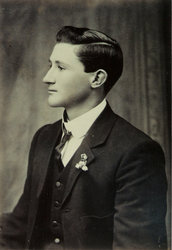
Giles Talbot Moore
Jane and Richard’s youngest daughter was Frances, known as Fanny.  She married Roy Stretton, and they called their fifth child Roy Giles.  Born in Bathurst in 1893, he enlisted in WW1 with his brothers Cecil and Clarence, serving in Egypt, the Sinai and on the Western Front, before returning to Australia in 1919.  He married Beryl Coleman in 1925 but they were separated by 1928 and divorced in 1934.  I have been unable to find any descendants

The sixth Giles in this generation was Alfred Giles Whitten, my great uncle, about whom I have written before.   His grandson Mark appears to be the only one of any of the successive generations of Whitten descendants who has inherited the name.

Mark Giles Whitten at the Giles Weather Station, 2019


*Mary Ann Mason’s obituary
4 Feb 1922 "The Methodist”
MARY ANN MASON (nee Sisley.)
Moruya Circuit lost one of its choicest souls recently when Mary Ann Mason was called home. She was born in Sussex in the year 1842. From her parents, Edward and Elizabeth Sisley, who were noted for their, piety, she received a sound religious training. In 1855, after the death of her father, she came with her mother and brother to Australia, in which country her uncle, Mr. Jacob Luck, a noted figure in Moruya Methodism,, had already settled. The family took up its abode in Kiora, near Moruya. Here Miss Sisley, at the age of 16, through the preaching of the late Rev. James Somerville, made - a full surrender of her life to the Lord Jesus.  About this time she lost her brother, and, then mother and daughter moved to Moruya. Here in 1869 Miss Sisley married Mr. Giles Mason, of Murrurundi, who pre deceased her by nine years. Excepting for a very short interval Mrs. Mason passed the remainder of a long life in Moruya. Every minister's family found in her a true friend. Her conversion proved to be a deep and abiding work of grace, for her experience proved that she was daily growing in grace and knowledge. Her life was a separated one from all she deemed worldly, and one noticed in her a deep affection for her church, so that her seat was only vacant when strong reasons prevented her attendance. Towards the end she was called to suffer much through a dread malady. Her faith only brightened under the test, for no cloud seemed to intervene between her Lord and herself, and no expression of doubt as to her position as a child of grace fell from her lips. Towards the close she longed for home, and on the day of her triumphant entry she- said, 'I 'm so happy, ' asking for her favourite hymn to be sung, My Faith Looks up to Thee.' She joined in the singing. Soon aiterwards she fell on sleep, proving the words to be true,' 'These Christians know how to die.' ' She leaves two daughters to mourn their loss.  Appreciative letters were received from two former ministers, Revs. J. H. Somerville and B. N. Hyde. — HJST.W.

*Singleton Argus 22 November 1940

JERRY'S PLAINS GIRL IN PALESTINE
LETTER FROM SISTER GRACE MOSS
Sister Grace Moss, with the Australian forces in Palestine, in a letter to her parents, Mr and Mrs GilesMoss, of "Hill Grove," Jerry's Plains, writes as follows:—
"I have just returned from a week's leave in Jerusalem, which was delightful. I saw more tombs and churches than one could imagine possible, and trod ground so historical of biblical times. At Bethlehem the Church of the Nativity was visited. It was really beautiful. I went down into the cave which was the manger. It is lighted with lamps, and is like a little chapel. One morning a visit was paid to the Dead Sea. The distance is not so far actually, and I was back at the hostel for lunch. Most of the country passed through on the way was hilly and barren—not a sign of vegetation until one came upon the town of Jericho, which was a patch of lovely green nestling on the shores of the Dead Sea. The latter is not at all pleasant to bathe in, though some of the girls did so.
 With others, I took a whole day and did the trip to Galilee. It was very beautiful, especially when we arrived at the sea. Tiberius, the oldest city in the world, is situated right on the shore The sea itself is the most glorious colour, and canoes and sailing boats dotted here and there on the surface make a pretty sight.
"A stop was made at Nazareth on the return trip, and I saw a church built over the workshop where St. Joseph and Our Lord were supposed to have worked. Just a short distance from the city is the Garden of Gethsemane and Mount of Olives. I walked the Via Dolorosa, or Way of the Cross, in the old city, and the crucifix which I bought and am sending to you I got at the Church Io Ecce Homo, which is built over the courtyard where Pontius Pilate condemned Our Lord to death."

Saturday, June 20, 2020

#52 Ancestors 2020 Week 25 Unexpected

#52 Ancestors 2020

Week 25 - Unexpected.


 My 2 x great grandmother Jane Armitage  emigrated to Australia with her husband, Richard Mason, but I was surprised to discover that the rest of her family – her parents and her  4 siblings all emigrated to the United States of America.  I wonder why?

Jane was the eldest of Richard and Phoebe Armitage’s children.  She was born in Ballingarry, County Tipperary in 1815, two years after Richard’s marriage to Phoebe Murray. At the age of 16 she married Richard Mason, also of Ballingarry.  Richard is described in the immigration documents as an agricultural labourer, but Ballingarry was also the centre of the coal mining industry in the 19th century, so perhaps some of his family may have been miners.

Jane and Richard had four children born in Tipperary – Phoebe (1834), Grace (1835) Giles (1837) and Eliza (1839).  In 1841 they set off from Cork for Australia as assisted immigrants on board the Woodbridge, arriving in Sydney on 8 March 1842.

It appears that Richard and his family travelled almost immediately to Bathurst, west of Sydney.  It was here that baby Eliza died and Charlotte, my great grandmother was born (July 1842).  On Charlotte’s baptism certificate, Richard is described as a shepherd, but he is also variously listed as a “dealer”, a “dairyman” an “ironmonger” and a “farmer”.  It wasn’t long before the family left Bathurst and moved to Emu Creek in the Hunter valley near Singleton where their next child was born in 1845.  This girl was called Elizabeth but was known as Eliza.   She and Charlotte were to go on to marry two brothers, Anthony and Henry Whitten.

Back in Ireland, there was trouble in Ballingarry. A rebellion against British rule broke out there on 29 July 1848.  A rebellion against British rule broke out there on 29 July, 1848.  The area was still in the grip of the potato famine, thousands of people had died and there was a great resentment against the English.  It was here in Ballingarry, during this uprising, that the national tricolour of green, white and orange was first unfurled, emulating the French rebels who had also taken to the streets with their tricolour for the first time earlier that year.  The site of this rebellion, known as the Famine Warhouse, is now a national monument.  (It’s a nice irony that the three ringleaders of this rebellion were sentenced to be “Hung, drawn and quartered” but were instead transported to Australia).

Famine Warhouse Museum today


Perhaps this unrest was the catalyst for Richard and Phoebe Armitage and their four unmarried children to make the decision to emigrate.  I wonder though, why they didn’t follow Jane, but chose instead to go to America.  They sailed from Liverpool and arrived in New York at Castle Garden (the arrivals port before the establishment at Ellis Island)on 3 December 1849.  Sadly, the ship’s list includes the crossed-out name of Phoebe, and the notation that she had died at sea on 8 November.


extract from Shipping record showing Armitage family

At this stage, Eliza was 30, William about 23, Phoebe about 16 and Richard jnr about 13.  They were all able to go to work.  The family settled in Wayne, New York, but we know that William later moved on.  There is a record in a collection of biographies of citizens of Livingstone County, Illinois, which charts his progress.  He worked mainly in the brick industry, he married a Miss Ann Thorp and together they had 9 children.  He was a devout Methodist and helped to build his local church.

We know little about the others.  Phoebe died in 1852, when she would still have been a teenager.  Richard married and he died in Auburn, NY in 1901.  Eliza seems not to have married until she was in her fifties.  As the eldest daughter she was probably thrust into the responsibility of looking after the rest of the family when her mother died.

Back in Australia, Jane and Richard’s family grew to eventually include 10 children and more than 60 grandchildren.  They remained in the Hunter Valley area, where Richard died at 54 after a fall from a horse in January 1863.  He was buried next to the church at Fallbrook but there is nothing there now to mark the place. After his death, Jane moved to live near her daughters Charlotte and Eliza and she died there, at Charlotte’s property Lowestoft on 16 November 1877.


Tuesday, June 9, 2020

#52 Ancestors 2020 Week 24 "Handed Down"

#542 Ancestors 2020

Week 24 - "Handed Down"


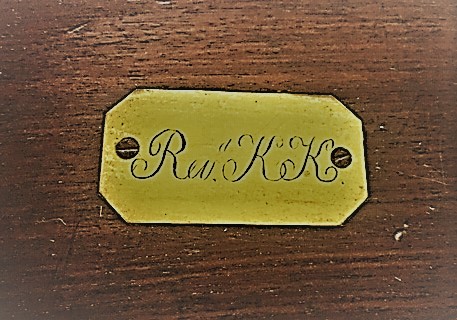
When my mother in law, Kathleen, knew she was dying, she spoke to all members of the family individually and gave each of them a keepsake.  She knew that I loved this box, and she gave it to me.


Known in the family as the “Priest’s box”, this is the portable writing desk of Father Kieran Kilroe, Kathleen’s great uncle, who was the Parish Priest at St Mary’s Athlone, Ireland from 1845 until his death in 1865.

Born in about 1799 in Shannonbridge, the village closest to the magnificent monastic ruin that is Clonmacnoise, Kieran was obviously a clever boy, destined to be educated into the priesthood.  He began at Clonfad, across the Shannon from his home, where a lay teacher of the old Hedge School*1 tradition taught Latin, then at about 18, he travelled to France to enrol at clerical college in Bayeux. *2

Kieran stayed in France for 7 years after his ordination in 1820, becoming Professor at a college in the South, but then he returned to Ireland to a curacy at Mohill, in County Leitrim.   In 1834, he moved to Athlone, becoming its Parish Priest in 1845.


One of his great achievements in Athlone was the building of the present St Mary’s Church (1857-62), a beautiful gothic revival church designed by the architect John Bourke, a prominent church architect of the period.  The Irish National Inventory of Architectural Heritage says that “the white marble 'stations of the cross', by George Collie and the white granite Renaissance-style monument to builder of the church,  Canon Kieran Kilroe, are noteworthy features to the interior. The cast-iron railings to the exterior and the fine gate piers complete the composition.”.
Memorial to Kieran Kilroe in St Mary's, Athlone

The principal beneficiary of Kieran’s will was his brother William Kilroe, who still lived in Shannonbridge and was regarded as a scholarly and learned man, and, like all the family, a staunch Nationalist.  He lived to be 90 years old and we think that he probably passed the Priest Box to his grand-niece, Katie Kilroe and that she passed it on to her niece, Kathleen.  It travelled from Ireland to Australia in the 1960s..

Brass name plate on the top of the box: "Rev. K K"


1*Hedge schools were small informal illegal schools, particularly in 18th- and 19th-century Ireland, designed to secretly provide the rudiments of primary education to children of 'non-conforming' faiths (ie Catholic and Presbyterian). Under the penal laws only schools for those of the Anglican faith were allowed

Historians generally agree that they provided a kind of schooling, occasionally at a high level, for up to 400,000 students by the mid-1820s. J. R. R. Adams says the hedge schools testified “to the strong desire of ordinary Irish people to see their children receive some sort of education.” Antonia McManus argues that there “can be little doubt that Irish parents set a high value on a hedge school education and made enormous sacrifices to secure it for their children....[the hedge schoolteacher was] one of their own”.[2]
While the "hedge school" label suggests the classes took place outdoors (next to a hedgerow) classes were normally held in a house or barn. Subjects included primarily the reading, writing and grammar of the Irish and English languages, and maths, (the fundamental “three R’s"). In some schools the Irish bardic tradition, Latin, history and home economics were also taught.
While all Catholic schools were forbidden under the Penal Laws from 1723 to 1782, no hedge teachers were known to be prosecuted. Indeed, official records were made of hedge schools by census makers. The Penal Laws targeted education by the Catholic religious orders, whose wealthier establishments were sometimes confiscated. The laws aimed to force Irish Catholics of the middle classes and gentry to convert to Anglicanism if they wanted a good education in Ireland. (Wikipedia)

2* Because of the penal laws, many young Catholics were educated in France at this time- including the great leader, Daniel O’Connell.

Tuesday, June 2, 2020

#52Ancestors 2020 Week 23 Wedding

#52 Ancestors 2020 Week 23

Wedding

Josephine Morgan on her wedding day


This beautiful bride is my grandmother, Josephine Dorothy Morgan, on the occasion of her marriage to my grandfather, Frederick Whitten, which took place on 9 August, 1911 in Tamworth, NSW.

Josephine, known as Jo or Josie, had not had an easy life to this point.  There are clues in the newspaper report to some of those hardships*

At the Methodist Church, Tamworth, on August 9, Miss Josephine Dorothy Morgan, of "Leicester Vale," Duri, was married to Mr. Fred Whitten, of Gaspard, Quirindi. The bride wore a dress of cream silk striped ninon over glace silk, richly decorated with pearl and silver trimmings, with the customary wreath and veil. She carried a handsome shower bouquet of white hyacinths, camellias, snow drops and asparagus fern, the gifts of the bridegroom also a costly diamond ring. She was attended by two bridesmaids, Miss Emily Maunder and Miss Lucie Whitten (sister of the bridegroom.) They were attired in cream ninon and carried lovely bouquets of pink and white hyacinths and autumn leaves, and they also wore pretty wreath brooches, gifts of the bridegroom. Mr. W Chalmers, of Tamworth, acted as. best man, and Mr. Dunning, of Duri, gave the bride away. Rev. James Colwell was the officiating clergyman, and Mrs. Colwell supplied the music. A goodly number of friends assembled to witness the ceremony, and afterwards adjourned to Mr Jarman's refreshment rooms, where the bride and bridegroom were the recipients of hearty congratulations. Upwards of 40 guests sat down to the wedding breakfast. The customary speeches were made and the usual toasts were proposed and honored. The bride's travelling dress was of saxe blue silk voile, nicely braided, with hat to match. The newlv wedded couple went to Toowoomba and Brisbane.

What a pity that local newspapers don’t do this anymore – we can learn so much from the report – the name of the Church, the names of the others in the wedding party, the bouquet and the gifts, the reception and the honeymoon destination.

We know that Josephine wasn’t given away by her father because she had not seen her parents since she was about 5 years old, and they separated.  Her mother went with baby Edward and was soon living with another man.  Her father took Josie and Elsie, her 2 year-old sister, to live with his sister (also Josephine) and her family in Summer Hill.  We don’t know if perhaps he visited in her early years but certainly, by the time she married, she had long believed that she was an orphan.

Both of her parents were actually still alive in 1911, but she was not to learn that until her mother died in 1933.

We know that her bridesmaid, Miss Emily Maunder, was the sister of her best friend, Ruth, who was supposed to be Matron of Honour but who had learned that she was pregnant.  Nobody could possibly have guessed, but it was considered “not done” to be a pregnant attendant to the bride.  

My mother wrote that “Josie had met the Maunder family when she was brought to Tamworth by family friends named Lonsdale.  Mr Lonsdale was a traveller for Buzacotts, a farm supplies firm now defunct.  He called on a Duri farmer named Will Maunder.  The Maunders took a fancy to my mother and asked her to stay on as a companion to their daughters Ruth and Emily.  While there, she was included in the social activities of the community, and it was during one of these that she met my father.”

We know that this was Fred’s second marriage and that his 8 year-old daughter, Gladys, was amongst the wedding guests.  The first marriage ended tragically when Annie Whitten died shortly after giving birth to Gladys in 1903.  She was 22 years old and they had been married for less than a year.  Josie became an instant stepmother - an unenviable position for a new bride.

Fred's brothers Harry and Tony, with Gladys at the wedding

Fred and Josie had a happy marriage.  They had seven children, but sadly lost their second son Jackie at the age of 6 and then their daughter Ruth at only 30.  Fred suffered from ill health in the last years of his life but was loved and cared for at home until he died in 1947 at the age of 76.  Josie lived for 21 years as a widow.  Her family was scattered throughout NSW, but she remained a central figure in their lives.

When I was about 11, my sisters and I “dressed up” in Josephine’s wedding dress.  I don’t think it fit me even at that age – my grandmother was about 5’ tall and Fred used to say he could “put his hands around her waist without her stays on”.  Fortunately, before it could be ruined by us, my grandmother donated it to the Quirindi Museum.

Monday, May 18, 2020

#52 Ancestors 2020 Week 21 Tombstone

#52 Ancestors 2020

Week 21  Tombstone


We are fortunate in genealogy research if there is a tombstone in place over an ancestor’s grave.  It tells us not only what is written on the stone, but that our ancestor is buried here, and that someone had the means to erect a memorial.  These are the easy ones.

More difficult are the ancestors whose memorials have disappeared, or who never had one in the first place.  Many of my forebears lie in places where there is no stone because no one could afford to erect one.  In some cases, there is no memorial because it has eroded away with time.  In North Lismore Pioneer Cemetery, which I wrote about last year (Week 22 – In the Cemetery) surviving tombstones were moved in the 1980s and placed against the side of a hill to protect them from flood and environmental damage.  Thus there is no knowing where exactly the grave is.  This has the added effect of removing context – we can often learn a lot from the people who are buried in the same area as our ancestor. Gradually the words on most of the Lismore stones are disappearing too.  When they go, some of the story goes too.

This is the tombstone of Paul’s 2 x great grandfather and there is a mystery at the heart of the words which will disappear when they fade away    why is Charles mourned by his “Mother, sisters and brothers” ?  Where is his widow?  Reading this headstone many years ago made us very keen to find out more about the circumstances of Charles’ death and his wife’s absence from the inscription.*
Charles William McCann 1851-1889

Paul’s maternal grandfather died in Dublin in 1920 and was buried in a paupers’ grave in the vast Deansgrange Cemetery.  His wife and two daughters emigrated to Australia a few years later, so the grave lay forgotten until a few years ago when Paul’s sister, Lorraine, went looking for it.  She bought the plot and arranged a headstone, which records it as the burial site of Robert Keogh, but not, sadly of the two other paupers whose remains are also interred there.  Robert Keogh’s wife and daughters never saw his grave, but his grandchildren and great grandchildren have visited it from Australia and the United States.

Grandson Paul McCann and great Grandson Brendan McCann, Dublin 2017

Another problem is the need for cemeteries to be relocated as “progress” catches up with their position. The first cemetery in the colony of NSW was the Old Sydney Burial Ground, situated on the edge of town and chosen by Governor Phillip and the Reverend Richard Johnson in September 1792. This is now the site of Sydney Town Hall.

 By 1820, the cemetery was full, so Governor Macquarie ordered the consecration of the Devonshire Street Cemetery in the growing town of Sydney.  Also called Sandhills Cemetery, this was the principal burial ground in Sydney from 1820 until 1866, when it was closed.  Then in 1901, the land was resumed to allow for the development of Central Railway station and representatives of the deceased buried there were given two months to arrange for exhumation and removal of remains.

Many other cemeteries were used but the majority of the remains went to Bunnerong Cemetery, south of the city.  A tram line was constructed to make the removal of recasketed remains as simple as possible. Bunnerong Cemetery was next to the Botany Cemetery and, in the early 1970s, was absorbed by that cemetery to create the Eastern Suburbs Memorial Park.

This is where we found the tombstone of Rosetta Johnson, Paul’s 4 x great grandmother who died in 1845.  She had come to the colony as a convict in 1815, having been sentenced to transportation for 7 years for the crime of stealing 18 yards of sheeting value 27 shillings and 1 shawl property of William Goff, value 30 shillings.  She travelled with her 6 year old daughter, Catherine, who was to marry Nicholas McCann, and in the colony she married John Beale, another convict, who became a loving stepfather to Catherine and a wise counsellor to others in the family.


It is now almost impossible to read the words on Rosetta’s tombstone.  They are:

“Rosetta Beale, wife of John Beale of Parramatta, died 13th Feb 1845, aged 65 years"


*The inscription on Charles' headstone reads:
"Charles McCann
Drowned in Wilsons Creek
April 15th 1889
Aged 38 Years
Leaving his Mother Sisters and Brothers
to Mourn their Loss
(4 lines of verse)
Erected by his loving Mother"

Wednesday, May 13, 2020

#52 Ancestors 2020 Week 20 Travel

#52 Ancestors 2020

Week 20 - Travel


 Very few Australians were privileged enough to travel to the other side of the world in the early 20th century.  It was a very long way, very slow and very expensive.  That’s one of the reasons why so many were eager to enlist when the Great War broke out in 1914 – In a letter to his mother, John Simpson Kirkpatrick remarked on the enthusiasm with which Australians had “embraced the declaration of war”. The idea that the war would be over by Christmas, and that this was a good opportunity to see the world, was not lost on many.*

My two great uncles, Albert and Alf, left Australia in 1912 on a different mission.  Both young men had trained as Methodist parsons, and their visit was partly to attend a Methodist Conference in Liverpool, England.  They also planned a visit to Ireland to the home and family that their father, Anthony, (my great grandfather) had left in the 1860s.

Albert Whitten 1912


The ship SS Osterley sailed from Sydney on 10 April 1912 and travelled to Tasmania, then to Melbourne, where they stayed several days. (Here Alf records his reading about the Titanic, which sank on 12 April).#

From Melbourne, they went to Adelaide and across the Great Australian Bight to Fremantle. On Sunday 21 April, Alf writes: 
 
Morning service was held on the top deck the preacher being Mr Steward (Church of Xst)(sic). He broke down in his voice and I filled in the breach. At 3pm we held a children’s service followed by a bible class.
AT 6.45 I conducted the service in the large dining saloon. About 230 people were present. The singing again was very good. I preached on God is Spirit, Light and Love. Every one gave me their best attention although at the time I was weak from seasickness.

On to Colombo, where they took a rickshaw to view the Great Buddhist temple and called on the American Baptist Mission before reboarding the ship and setting off for Suez, where they disembarked at Port Said and took a train to Cairo.

There is ample photographic and written evidence of the attractions of Cairo experienced by the young Australians who found themselves there at the beginning of World War 1.  Alf and Albert did the tourist trail too – they visited the Sphinx and the Pyramids and the museums, but they also found time to go to church and to the American Mission.  They were very serious young men.

Alf Whitten in 1912


They took a steamer to Jaffa and then went on to Jerusalem by train.

From the diary:

The route is by luxurious gardens and orange and lemon groves and every mile of country through which the track runs is associated with events in the early life of the Jewish nation. The first station is Lydda, the home of St George
the dragon killer, and the scene of many exciting events during the Crusades. Next is that of Ramleh, the reputed home of Joseph of Arimathaea. At the railway stations are crowds of children and women with great nosegays of brilliant colours which they offer for a penny, and large baskets
of oranges and other fruits for any price that the passengers will pay. We cross the famous Plains of Sharon whose fields are radiant with wild flowers – myriads of narcissus, blue iris, rose of Sharon, and lilies fo the valley. In this Valley of Sharon the flower of chivalry, the gallant Crusaders fought; over yonder is Timnath where Samson set fire to the Philistines’ corn; we pass the Valley of Ajalon where Joshua commanded the moon to stand still; and the little village over the next slope of hills is Kirjath Jearim, where the Ark remained for twenty years in the house of Abinadab. Soon the train winds out into the dark gorges of the mountains, crosses the boundaries of Judea and eventually Jerusalem.

From Jerusalem the two men travelled to England via Europe.  The diary records that in Paris they saw an aeroplane, probably the first they had ever seen.  Unusually for a couple of Methodists, they visited the Vatican.  In England they went to Crystal Palace for a performance of Handel’s Messiah with a cast of 4000 – an event which Albert referenced in his Easter sermons for years afterwards.

I was especially interested in their experiences in Ireland, where they stayed at Fancroft, the family home near Roscrea from which their father had departed more than 40 years before.  The incumbent was Ned Whitten, their cousin, and his family which included his small daughter Marjorie.  It was she who welcomed me when I visited some 50 years later.

Most of their time here was spent in visiting and drinking cups of tea with various relatives but Alf also notes:

Attended the Fair in Roscrea. It seemed strange to see cattle sheep and horses, pigs in the streets and the buyers and sellers chatting and driving a hard bargain. There was a fine little mob of Irish ponies, rounded up in the streets. 42 publicans in Roscrea…

And on Sunday 4 August:

11am attended Methodist Church, Roscrea and heard Rev. Harris preach then at 12 went to Church of Ireland and heard a good sermon from a curate. Afternoon sang, talked. Evening took the service for Rev. Harris. 1 Cor. 1.31. Good congregation, good singing. Fair time in the pulpit.

Fancroft - undated photo

Alf and Albert sailed for the United States on the four funnel “Olympic” the sister ship of the Titanic.  They enrolled at the Drew Theological Seminary in New Jersey, but Alf left after six weeks and began his journey home, travelling via Canada, Hawaii and New Zealand.  Albert stayed on at Drew for a year, then transferred to Boston University School of Theology before being ordained and accepting a parish in Maine.  He married in the United States and lived there for the rest of his life.

Alf came home and married his sweetheart, Ethel, the following year.  He began a long career as a Methodist Minister across NSW.

Alf’s grandchildren and other family members of their generation have travelled often and easily to Europe, to the United States and Canada, and especially back to Fancroft, which was sold out of the family after more than 300 years in 2016.  While we would all no doubt attest to strange and wonderful experiences, it is difficult to imagine the wonder that these two farm boys must have felt at the exotic sights and sounds of their voyage in 1912.

*Anzac Voices, Australian War Memorial
# The SS Osterley did service with the AIF as a troopship during WW1.


Wednesday, May 6, 2020

#52 Ancestors 2020 Week 18 Where There's a Will

#52 Ancestors 2020

Week 18 "Where There's a Will"

Some of the family at Lowestoft, 1914


The prompt for Week 18, "Where There’s a Will", sent me looking among Mum’s papers for details of the wills of her grandparents, Anthony and Charlotte Whitten.  They are interesting not because they are controversial (as many wills are) or because they were rich (they weren’t) but because of the detail contained of their possessions, all of which had to be assessed and valued in the days when Australians paid death duties.

Anthony died in 1914 and left everything to Charlotte.  The Government decreed that the total net value of the Estates on which duty is payable is Twelve Thousand five hundred and twelve pounds eleven shillings and four pence.  If it was calculated at the same rate as for Charlotte, 14 years later, then it was over 750 pounds.

This is what was valued.  The total area of the land was 2595 acres – that’s over 1050 hectares.  It was all grazing country except for a small area around the homestead, which was described as a 4 room slab cottage with a kitchen and a skillion storeroom.  There was an iron woolshed with yards and pens, an old 3 roomed slab hut with a bark roof, a horse paddock, a small calf paddock, yards and cow bails, a vegetable garden and another garden  with old fruit trees, and miles of fencing.
The high mountainous country is described as “still uncleared, timbered with stringybark, gum and peppermint”

In 1914 there were 570 ewes, 370 lambs and 900 wethers.  Amongst the 23 cattle are 4 working bullocks and 4 milk cows with calf.  Anthony had 9 horses, which would have included sulky horses as there is a sulky and a “spring cart” amongst the plant.  The value of the livestock was calculated at One thousand and six pounds, 10 shillings. The last wool clip had realised 621 pounds, 8 shillings and 3 pence.

It’s difficult to make any assessment of what that money represents today, but I think we can assume that Anthony was running a successful sheep farming operation.

Nevertheless, they lived simply.  Here is a list of the dining room furniture as presented for valuation.

The Dining Room:
1 table
1 Sideboard
1 Daisy Cot (I had to look this up – it’s a kind of camp stretcher)
1 Cane chair
1 small deal table (home made)
1 small bamboo table
1 small clock
2 lamps (valued at 2/- and 2/6)
1 cruet stand
4 tumblers (3d ea)
1 stool.

Charlotte died in 1927.  Two of her unmarried sons lived with her and worked on the property. The land holding had increased slightly to 2648 acres of grazing country with a total assessed valuation of 8485 pounds and 5 shillings. There were fewer sheep but more cattle – 1597 head of sheep, 90 head of cattle, 25 head of young calves and yearlings, 3 pigs, 2 horses (one old and one very old) and 28 fowls. There was one old Sulky and one very old Spring Cart in bad condition.

There was more Dining Room furniture:

Linoleum on the floor.
Deal Table
Rocking Chair
5 Pine Chairs
I small deal table
Victor Piano
Clock
Sewing machine
Small couch
Meat Safe
3 Kerosene lamps
I Small Lamp.

The total value of the estate was calculated at 15,501 pounds and duty was 930 pounds I shilling and 2 pence. 

It’s highly likely that members of the family may have manipulated the amount payable for death duties by removing some possessions from the property.  Payment of death duties was a huge imposition on families and many properties would have to be sold in order to pay them. ( This was particularly the case in England when death taxes were blamed for the sale or demolition of large numbers of stately homes during the first half of the 20th century.)  Death duties were abolished entirely in Australia after Queensland took the lead in 1979.

Lowestoft 1914