Monday, January 9, 2023

52 Ancestors 2023 - Week 2 - Favourite Photo

 52 Ancestors 2023 - Week 2 - Favourite Photo

John William Gleeson 1889 - 1961

My paternal grandfather, John William Gleeson, universally known as Jack.  My sisters and I call this photo “Jack the Lad” – he looks cocky and self confident.

Jack was the firstborn of James Patrick and Mary Gleeson (nee Crummy), born at Leongatha in Victoria.  We don’t know why they were in Victoria – they moved soon afterwards to Lismore on the North Coast of NSW where their next 5 children were born, the fifth in 1901.

Jack had the rudimentary education of poor country boys at the time – he probably left school at 12.  His father had labouring jobs and worked on the railway for a time.  When Jack was about 10, his father was declared bankrupt * so times must have been tough.

My father wrote about his father’s work as a young man:

“At one stage, he was apprenticed to a tailor, and then to a cabinet maker. In both cases the apprenticeships were short-lived, for what reasons I never learned. One result of the first was that he never hesitated to sew on his own buttons, and, of the second, it inspired a lifelong love of woodwork which was the basis of one of his hobbies. He drifted, however, in his teens, into a variety of jobs, most of them labouring. For a time, he was a wharf-labourer, Lismore then being a port of some consequence. He spent a season cane-cutting in Queensland. He also worked at cutting out the water hyacinth spreading in the river and hindering the movement of the ships that provided the link between Lismore and Sydney. This job came to a sudden end when he inflicted a bad gash in the calf of his left leg with a razor-sharp axe that was the main implement used in the job. Again, he spent some time shovelling coal at the Lismore gasworks. During this period of his life, he was never afraid of work, but he had a short fuse and rarely held a job for long. In addition to his proneness to argue with the boss, he was also developing a taste for liquor which did not endear him to his employers.

Jack married Alice White when he was 21 and she 20.  I think she was probably pregnant as the wedding was very quiet.  I can’t imagine that her parents were very pleased – her father was a very well respected member of the town Council and Jack was not a good catch.  The Gleesons were Catholics, at a time of sectarian divide in Australia, and the family were poor, uneducated and unskilled.

His wayward work life continued as the first three of 6 children were born.  Then with World War I in its second year, he enlisted.

His WWI service papers show that he enlisted in May 1917 and began training at the Enoggera Base in Brisbane.  In September he was discharged.  Dad believed that he had been found unfit; 

his papers say that he was discharged at his own request “for family reasons”.

Soon afterwards he was involved in an altercation at his parents’ hotel which made the Brisbane papers.

James and Mary were the licensees of the Regatta Hotel at Toowong, in Brisbane. Jack was arrested there for using offensive language.  In the course of the arrest, Jack allegedly knocked the Constable to the ground, James Gleeson allegedly assaulted him and Mary Gleeson hit him on the head!

The saga played out in the press for a few days before Jack was fined 2 pounds and his mother 1 pound.

I wonder if it was the sobering affect of this which led to Jack returning to his family and joining the railways as a blacksmith striker, the first permanent job he had ever had.  He modified, and eventually gave up alcohol, and family life became more peaceful.

I guess it was about this time that he joined the Manchester Unity Independent Order of Oddfellows (MUIOOF) in which his father -in-law and other members of the White family were prominent.  He became a JP, and he acted as a campaign manager for several successive (but unsuccessful) Labor Party candidates in the Lismore electorate.

Dad wrote:

 Anyhow, round about 1920, Dad gave up drinking altogether and thereafter became a typical householder, with a garden, a few fowls, a taste for household repairs and so on. His railway job changed a bit. He progressed from blacksmith striker to fitter’s labourer and thence to roster clerk. None of these jobs involved much improvement in his pay, but they did involve an increase in responsibility which was good for his self-esteem.

Jack in full MUIOOF regalia

The Great Depression put an end to this new found harmony.  My grandmother was bitter about it for the rest of her life, and now I can see that it effectively ended her marriage.

As a government employee, Jack suffered immediately from the measures imposed by the Lang government – first threepence then one shilling in the pound deduction from his wages.  Then the rationing of work, so that he worked two weeks out of three (and was unpaid for the unworked week).  In 1928 their last child had been born and although the eldest was now working and Dad was at University on a scholarship there were still 6 mouths to feed. 

The final straw was the Railway decision to move their headquarters from Lismore to Casino, about 20 miles away.  These days it’s an easy commute – in 1932 it meant that Jack had to move to Casino during the week and try to get home to see his family on Saturdays.  In view of the financial privations already imposed, this was difficult.

Nevertheless I believe the marriage hung on through the 1930s.  Jack and Alice were still at 8 Webster St together for the 1937 census, and it was at this time, I think, after he had left the railway, that he bought a small service station in Casino.  There are family rumours that there was another woman in Casino- whatever the reason sometime early in the 1940s Alice took Margaret, her youngest child, and moved to Sydney.


The service station in Casino.

As children, we didn’t question why our grandparents came to visit separately, although I recall those infrequent visits now. He was always loving towards us and interested in our lives and he and Dad seemed to get on well together – they had a shared interest in woodwork and I remember him helping with carpentry jobs around our house.

By late 1950s, Jack and Alice were back together at her home in Hurstville (a suburb of Sydney).  They had separate bedrooms, but the relationship seemed amicable enough.  He kept chooks and grew vegetables; she kept house.  I don’t know if he already knew that he had the lung cancer which finally killed him in March 1961, but she nursed him until the end.

Alice and Jack 1960

I have come to soften towards Jack as I’ve researched this.  He has long been regarded in the family as unworthy of our staunch and hard-working grandmother, and it’s certainly true that he wasn’t a model husband.  But given his tough early life, what we would now call “poor parenting” and then the Depression, his trajectory is, while not excusable, understandable.


Sunday, January 1, 2023

52 Ancestors 2023 - Week 1 - I'd Like to Meet

 52 Ancestors 2023 - I'd Like to Meet


                                                                  Frederick Whitten

I met all but one of my grandparents when I was a child, and both of my grandmothers were still alive when I was a young adult, but I never met my maternal grandfather, who died two years before I was born.


Frederick (Fred) Whitten was born in 1871 at the family property, Lowestoft, near Quirindi, NSW.  He was the fourth child and third son of Anthony and Charlotte Whitten (nee Mason) who had settled on their property at the time of their marriage in 1865.   There would be 9 more children including twin boys who died as babies.


Fred and his siblings were educated at the little school built by their father on the property, but like most children of the time his formal education ended around the age of 12 and he began to work on the farm.

                                                      Lowes Creek School -Fred 4th from left

We know little about his early years but can assume that it was a life of hard work tempered by time with his large extended family and the activities of their church.  He was known as a good stockman and a good shearer (in the days of blade shearing). Their mother, Charlotte, was particularly religious and in the early years attended her nearest church (10
miles away at Wallabadah) on horseback or by cart.  All the children would have accompanied her.


In 1902 Fred married Annie Florence Newcombe in Tamworth, NSW. He was 31 years old and she was just 21.  Sadly, within a year Annie had died in childbirth, leaving baby Gladys and her devastated young husband.  Her headstone in the cemetery in Tamworth is testament to his grief.

 It reads:

My dearest Annie has left me,

And gone to realms above;

My heart seems torn within me.

Yet I know that God is love.

She left me in the bloom of youth

When her course seemed just begun,

In grief and pain, I try to say

My God, Thy Will be Done


Fred and Gladys were fortunate that he had a large extended family around them.  Gladys was adored by her grandparents and bachelor uncles who all rallied to help.

Eight years later, Fred met Josephine Morgan at a picnic at Duri, not far from his home at Gaspard.  My mother said that ‘when he saw her step down from her cart, dressed in yellow, he was instantly smitten.”  They were married in the Methodist Church in Tamworth on 9 August 1911.

Josie was a Catholic, and a city girl but she willingly became part of his Methodist Church and threw herself into rural life. She became a life long member of the CWA (Country Women’s Association) and lived the rest of her life in the Quirindi community.

The first of Fred and Josie’s seven children arrived in 1912 – my uncle Keith Wesley Whitten.  He was followed by Jackie (1913), Ruth (1915), Connie (1919) Royce (1921) Gwynne (my mother, 1924) and Joan (1928.)

The growing family lived at Woodstock, Fred’s property next door to Lowestoft until 1924.  Jackie died accidentally (in 1920) and in 1924, while she was pregnant with Mum, Josie was thrown from the sulky as it was being driven to town.  Her hip was broken, and because of her pregnancy (and probably also because of limited medical treatment available to her) it was never set properly.  Although Mum was delivered safely at full term, her mother walked with a limp for the rest of her life.

In response to this accident, my grandfather bought a house in town and henceforth he commuted to the farm, spending weekends with the family at “The Meadows” in Fitzroy St, Quirindi.

My mother described it thus: ‘Dad would arrive in time for lunch on Saturday, having already been into town and placed his order for supplies for the coming week with one of the three grocers in town (he would patronise all of them in turn).  After lunch he would have a nap and then at night we would all be together at home.  Occasionally he and Mum would go out to the pictures or, if they were in town, to Sorlie’s (travelling show).

On Sunday mornings we would all go to church, then come home for a big lunch, often with other members of Dad’s extended family.  Afterwards there would be a big afternoon tea, then church again at night. 

On Monday morning Dad would go back to Woodstock for another week’s work.”

In about 1941, Fred suffered a stroke.  I don’t know the details, but he spent some time in Sydney and then came home to be nursed by Josie for the rest of his life.  Keith and Royce were already working on the property (although Keith enlisted and was absent during the war years).  Ruth and Connie were both married and Joan still at school.  Dad apparently told Fred around this time that he shouldn’t worry about Mum, because he was going to marry her (she was only 17 at the time).

He died in October 1947.  His obituaries in The Quirindi Advocate and The Methodist both describe a man of great integrity and kindness, dearly loved by his family and friends and regarded highly by his community.

I have two treasured mementoes of my grandfather Fred, both given to me by his youngest daughter Joan.  They are a little leather coin purse which he always carried in his fob pocket, and a silver spoon from Woodstock.

I wish I had met him.


Sunday, April 24, 2022

52 Ancestors 2022 - Week 7 - Landed

52 Ancestors 2022 - Week 7 

Landed

Fancroft

This is Fancroft, family home of the Whittens, my mother’s family, from the late 18th century until it was sold out of the family in 2016.

My earliest record of it is as the home of my third great grandparents, William and Prudence Whitten (nee Clery, (or Cleary).  William and Prudence were married in 1780, and by the time their son Edward was born in 1795, they were living at Fancroft, just outside Roscrea in County Tipperary.

Edward was their sixth child and he and his bride, Martha Lucas also lived at Fancroft.  Death records are not clear, but Whitten family historians think that Edward was the oldest surviving son at the time of his father’s death.

Edward and Martha had 12 children.  Little is known about the first two sons, Robert (b 1822) and William (b 1823) The next three children were girls – Matilda, Eliza and Mary, and then the next son, Edward, died at the age of three.

Edward senior died in 1850, and perhaps Robert or William may have inherited Fancroft on his death, but it was John (b.1833) who eventually took over the property, and his family line which remained.

The five children who were younger than John all emigrated to Australia, but Fancroft remained strong in their memories, and they passed this on to succeeding generations.

The first to return were Anthony’s sons, Alfred and Albert, who visited in the summer of 1912.  Alf kept a diary which describes the house and many of the family they met while they were there. #

The story in the family is that John Whitten’s third son, Joseph Abraham Whitten was named as his father’s heir, but that the eldest son, Edward, who had gone to Canada, returned, burned that will and claimed Fancroft for himself.  Edward was married to Charlotte Wallace and had seven children and it appears that the first two sons both emigrated to Canada when quite young.

(When I met Marjorie in 1977, I asked her about all the emigrations to Canada and the USA in the family.  She said, “every time there was a family fight, someone emigrated”, so perhaps these two sons were at odds with Edward?)

I think that the third son, George Washington Whitten must have taken over the farm after Edward’s death in 1930.  There is a record of George and Lily and their son Eddie travelling back from Canada to Ireland in 1933, but I don’t know if they had been resident there or if it was a short visit.

George died in 1951 and I assume that this is when Marjorie took over the running of Fancroft At some stage she was joined by Billy Williams, son of her sister Frances, and he inherited the property on Marjorie’s death in 1977.

All the Australian members of the extended family who visited Fancroft have commented on the coat of arms (see below) and the enormous kitchen with its stone flagged floor and magnificent display of copper pots and blue and white china. The “Whitten descendant” who wrote a lengthy piece dated 1966 and reproduced on Tim Hobson’s “Whittens in Australia” webpage describes a busy working kitchen with a creamery and pantry and a churn still used by Marjorie twice a week.  Sadly, by the time of my sister Margie’s visit in 2012 the kitchen was empty of all but a table – Billy Williams was taking his meals with his neighbours.

When Billy died in 2016, Fancroft was put on the market and when I was there in 2017 it presented a sorry site.  We were told that the new owners had wanted only the land and had no interest in the house, which was empty and abandoned.  After 300 years in the Whitten family, it is slowly falling into disrepair.


#Monday 5th

In the morning we went out to Joe Whitten’s and had dinner. He has 45 Irish acres of land. Irish acres are 1¼ acres. Had tea there and met Francis Rorke who asked us to her (his?) place.

 Tuesday 6th

Went into town and had a good look through the co-operative bacon factory. Killing, scraping and singeing etc. The we called on John Mason once more. Had dinner at Luttrells, called on Daley the C of E curate who was out then back to tea at Luttrells where we met old Mrs Drought who knew Father well. After tea we went to the old Roscrea Castle. This seems to be a very old stronghold from the top of which one could see all the district round about. Singing and home.

 Wednesday 7th

Morning quiet time at Fancroft. Afternoon shooting. Evening chatting in the Home.

 Thursday 8th

Attended the Fair in Roscrea. It seemed strange to see cattle sheep and horses, pigs in the streets and the buyers and sellers chatting and driving a hard bargain. There was a fine little mob of Irish ponies, rounded up in the streets. 42 publicans in Roscrea...


Wednesday, April 6, 2022

52 Ancestors 2022 Week 13 - Sisters

 Week 13 - Sisters


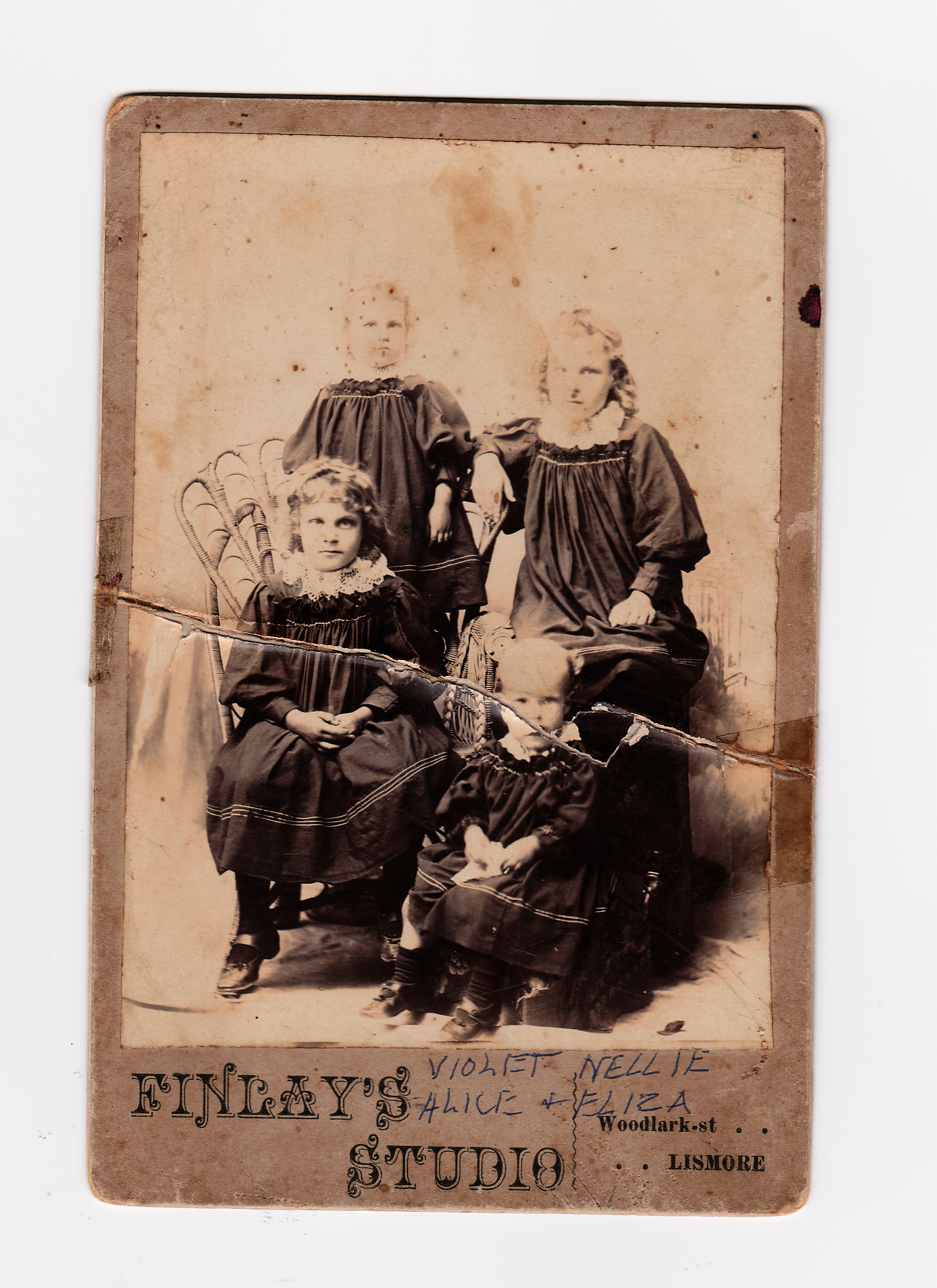
                                           Violet and Nellie at rear, Alice and Weenie in front


 My grandmother Alice White was the second of Robert and Elizabeth White’s seven children and 4 of her siblings were sisters. She remained close to all of them through her long life.

First in the family was Nellie (Ellen) born in September 1888. (For a reason we will never know, her mother’s parents refused to give their permission to a marriage, despite Elizabeth’s pregnancy, so Robert and Elizabeth were not married until July 1888, the day after Elizabeth turned 21).

Nellie married at 19 to Victor John Lehman and I assume she too was pregnant at the time as baby Ann was born within eight months of the wedding.  She was the first of six children, who grew up close to their grandparents, in South Lismore.  Nellie shared her father’s love of gardening and was a very successful exhibitor at the local shows, winning 22 prizes at the South Lismore Horticultural Society Show of 1935 and also becoming a judge at other regional shows.  Two of her daughters became florists.

The marriage seems not to have been very happy – Vic was a moody and jealous man.  This came to a head one night in 1945 when he argued with a house guest who was the boyfriend of his daughter Marie – they were both living with her parents at the time.   During the night Vic took his rifle and shot the guest, then pointed the gun at Nellie, who hid from him.  When she emerged from hiding, he was gone.

The next morning, Vic’s body was discovered at the river bank near their home.  He had shot and killed himself.  Marie’s boyfriend recovered.

Nellie lived on for 42 years, with most of her extended family around her.  She died at 98 in June 1987.

The sister after Alice was Violet, born in 1893.

Like the others, Violet would have been educated to the standard of the time, finishing her formal education at the end of primary school.  I know little about her until her wedding, described in great detail in the Northern Star on 28 November, 1912.#.  Her new husband was Roy (Royal) Goldsmith, born in Napier, NZ,  who was a tailor with a business in Lismore.  I don’t know much about their lives but they had two children, Edwin (Eddie) born in 1914 and Edna (b. 1916). Eddie Goldsmith grew up as a mate of my father in law, Pat McCann, and was the best man at his wedding to Kathleen in 1936.

Violet and Roy are both buried in Lismore. She was 78 when she died – not a long life by the standards of the family.

I know very little about the next sister, too. Eliza Jane was born in 1895 and was immediately dubbed “Weenie”, a nickname she carried all her life. (I remember Alice referring to her as “Ween” when she was very old).  Weenie married James Henry “Jim” Wood when she was only 17.  They had five children and spent most of their married life in Nimbin, where Jim was a baker.  He died at only 51, and a few years later Weenie remarried.  Her second husband was Francis Harley, a dog trainer, and they lived in North Lismore.

Weenie was only 64 when she died in 1959.

I have a postcard that Weenie wrote to Alice in about 1910.


The youngest girl in the family was Mabel May, always known as “Sis”.  She was born in 1900 and outlived all her siblings except George, the baby of the family.

Sis married Walter Day in 1920, and they had five children in the next 11 years.  Two of their daughters, (Joyce b. 1923 and Merle b 1929) are still alive at the time of writing. Their son, Alan, died as a small child in 1927.


Apart from a short time in Sydney, Sis lived in South Lismore all her life, then moved to a Lismore Nursing Home.
 Interviewed for the Northern Star when she was 88, she recalled the day that her father brought Billy Hughes home for lunch.  Hughes was campaigning in Lismore and Robert White would naturally have been involved in providing hospitality.

She died at the age of 91.


# I think the elaborate nature of this suggests that Violet was the first of Robert and Elizabeth’s daughters not to have been pregnant at the time of her marriage and therefore, in the manner of the times, able to have a big church wedding.


Tuesday, January 18, 2022

52 Ancestors 2022 Week 3 Favourite Photo

 52 Ancestors 2022 Week 3

Favourite Photo


I love these two photos, the only ones I have of my mother as a baby.  I particularly like the contrast between the formal pose of the five children and the very ragamuffin look of the snapshot.

 Mum looks less than a year old in the group photo, so it was taken in 1925.  Her oldest brother, Keith (b 1912), and oldest sister, Ruth (b 1915), are standing behind her.  Missing between them is their  brother, Jackie, who died when he was 6 years old,  in 1920.

 These two older siblings were too much older than Mum to be playmates and both were married while Mum was a young teenager.  Ruth’s marriage took her away from Quirindi, their home town, and Mum saw her again on only  a few occasions before her untimely death in 1945, although they wrote regular letters to each other. 

 Connie, born 1919, was five years older than Mum so she was a teenager while Mum was still a small child. She looks very serious in this photo, holding a spray of flowers in her lap and with her feet neatly crossed.   Mum recalled her dressing up for parties and balls and doing some of the dances of the time – the Charleston and the Black Bottom. 

 Nearest in age to Mum was Royce, born in 1921, and he sits on Mum’s left with a characteristic lop-sided grin and one leg tucked up – a surprisingly informal touch in such a formally posed picture.   

 It is Royce who is the older child in the other photo.  Until the arrival of Joan (b 1928), the last of the family, it was he who was Mum’s closest playmate. 

 This photo has a handwritten note from my grandmother on the back, which suggests that it was sent to Mum many years later. It says, “I am putting in this for you to keep of you and Royce of yourselves in gone days.  Mum” 

 It is always poignant to see the handwriting of someone who has been gone so long.

 Both the children are rugged up against the cold, although Royce wears short pants as little boys always did. 

 The car is interesting.  My grandfather had always had horses and carriages for his trips to town until the accident in 1924 which threw his wife and children into the creek and broke my pregnant grandmother’s hip.  It looks as if he had bought a car by 1926, when this photo was taken.  It’s a T model Ford -very popular at the time. 


Saturday, January 15, 2022

52 Ancestors 2022 - Week 2 Favourite Find


52 Ancestors 2022 Week 2

Favourite Find

 This is not, strictly speaking, a “find”.  I always knew it was there.  But having a close inspection of my grandmother’s wedding dress, almost 110 years after the wedding, was very exciting and very moving.

 I have written before (52 Ancestors 2020 – Week 41) about visiting the museum in Quirindi, NSW and being able to see my grandmother’s dress.  I had seen it before, when I was about 11 years old, and my sisters and I had actually tried to wear it.  Even at 11,  I was bigger than my tiny grandmother.

 Fortunately, it was soon after this (before it could be ruined by other fascinated children), that my grandmother donated it to the museum.

 Knowing of my impending visit, the volunteers of the museum had retrieved the dress from its tissue-lined archive box and laid it out for me.  For many years it had actually been on display, worn by a mannequin, but the fabric is now too frail for it to hang.


A description of the wedding appeared in the Tamworth Daily Observer on 16 August, 1911.  In it, the dress is described thus:

The bride wore a dress of cream silk striped ninon over glace silk, richly decorated with pearl and silver trimmings, with the customary wreath and veil.

The cream silk has darkened now, and the glace silk underlining has disintegrated in places.  The silver trimmings have tarnished to a rather dramatic dark grey, but the pearls are still intact.  The rich embroidery is still evident, and most of the silk tassels on the sleeves and hem remain.


The newspaper account continues:

She carried a handsome shower bouquet of white hyacinths, camellias, snow drops and asparagus fern, the gifts of the bridegroom also a costly diamond ring. 

It doesn’t mention the horseshoe attached to the bouquet, which was traditional for brides of the era.  Still attached to its ribbon, it lies with the dress.


I am so grateful that the volunteers of this small country town museum care for this precious relic of my family’s – and the town’s – history.


Saturday, January 1, 2022

52 Ancestors 2022 Week 1

52 Ancestors in 52 Weeks 2022 - Week 1

Foundations


The foundations of my interest in family history are the stories.

I was lucky to grow up with parents who talked about their childhoods and told their family stories.  My mother was a legendary storyteller who told stories that were funny or sad with the attendant laughter or tears as part of the tale.  My father was less emotional, but I realised when I began to think about this theme, that I knew a great deal about his family from the stories he told.  He was particularly attached to his mother’s family, the Whites, and very proud of their contribution to the life of his home town, Lismore, NSW.

So, when I began to research the family history, it was to flesh out the bones of these stories from my childhood.  To know more about the people who they spoke of, and perhaps to verify too that the stories were true.

I was curious about the people I had no stories for.  Who, for example, was my maternal great grandmother who had disappeared so totally from my grandmother’s life in her early childhood that she was believed to be dead, only to reappear when her death was announced some 46 years later?

And what was the real reason for my paternal grandmother’s often-voiced antipathy towards my great-uncle Michael?  Was he really an alcoholic wastrel?

Over 40 years of research I have found the answers to both of these questions and uncovered many more secrets and lies within the family stories.

In 2022, I will be looking for more.